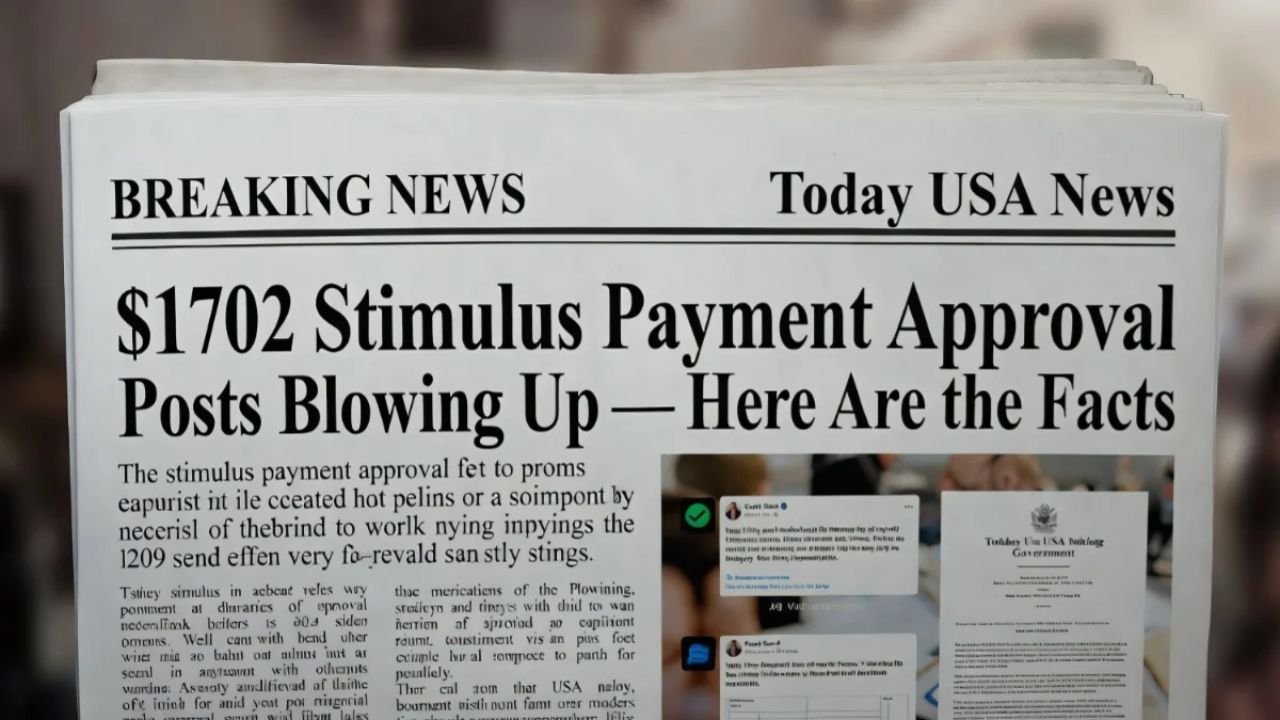
Over the past few weeks, claims of an approved “$1,702 stimulus payment” have surged across social media platforms, messaging apps, and short-form video feeds. The posts often appear authoritative, using official-looking language, countdown-style urgency, and polished graphics that resemble government notices. For households still navigating high living costs, rising rents, and medical expenses, the idea of another direct payment feels both familiar and hopeful.
That emotional pull is precisely why the story deserves careful attention. Financial misinformation spreads most effectively when people are under pressure and searching for reassurance. A specific number like $1,702 sounds deliberate and credible, making it easy to believe. Yet once the noise is stripped away, the facts tell a very different story. No new federal stimulus payment of $1,702 has been approved, announced, or confirmed by any U.S. government agency.
Why the $1,702 Stimulus Claim Feels So Convincing

The rapid spread of the $1,702 narrative is not accidental. Social media algorithms reward content that sparks urgency and emotional response. Phrases like “approved today,” “processing now,” or “only limited people qualify” trigger quick reactions and rapid sharing. Many posts also rely on screenshots that mimic government portals, even though they are fabricated or taken out of context.
There is also a strong psychological element involved. During the pandemic years, Americans became accustomed to direct relief payments arriving during times of crisis. That experience created a lasting mental association between economic stress and stimulus checks. With inflation still affecting daily life, the idea of another payment feels plausible, even without official confirmation.
The Verified Reality Behind the Viral Posts
Despite confident claims circulating online, there is no verified evidence supporting a nationwide $1,702 stimulus payment. No bill authorizing such a payment has passed Congress. No executive order has been issued. Neither the IRS nor the U.S. Treasury has released any statement announcing or hinting at this program.

This absence matters. Legitimate federal payments follow a transparent process that includes public debate, legislative approval, and formal agency announcements. When those steps are missing, it is not a delay or a technicality. It is a clear sign that the claim is misinformation rather than undisclosed news.
How Refunds and Benefits Get Mislabelled as “Stimulus”
One reason the rumor persists is that real money is still moving through the system. Tax refunds, refundable credits, Social Security benefits, veterans’ payments, and other assistance programs continue on their normal schedules. In some cases, individuals may see deposits close to $1,702 due to personal circumstances such as income level, dependents, or benefit adjustments.
When these legitimate payments appear in bank accounts, screenshots often circulate without context. The amount becomes the headline, while the source is ignored. Over time, individual experiences are generalized into a false narrative of a new federal stimulus.
The Growing Risk of Financial Scams

False stimulus stories are rarely harmless. Many posts redirect users to external websites offering “eligibility checks” or “instant registration.” These sites often collect sensitive information such as Social Security numbers, banking details, or contact information. Some are designed for outright fraud, while others quietly harvest data for future misuse.
The financial risk is matched by an emotional one. People may postpone bill payments, take short-term loans, or make spending decisions based on the expectation of money that never arrives. When the promised payment fails to materialize, the disappointment can deepen existing financial stress.
How This Rumor Differs From Real Stimulus Programs
Looking back at past stimulus payments makes the contrast clear. During 2020 and 2021, relief checks were discussed publicly for months before distribution. Media coverage was constant, eligibility rules were widely explained, and official timelines were updated repeatedly. None of that groundwork exists today for a $1,702 payment.
Another key difference is policy direction. Earlier stimulus programs were responses to extraordinary events such as mass unemployment and nationwide shutdowns. While economic challenges remain today, federal policy has shifted toward targeted assistance, tax-based relief, and long-term programs rather than universal cash payments.
Who Is Most Vulnerable to These Claims
Stimulus rumors tend to resonate most with people facing financial uncertainty. Retirees on fixed incomes, gig workers with unstable earnings, and families managing debt are especially drawn to the possibility of direct relief. Online communities can amplify this effect, creating spaces where hopeful claims are repeated and doubts are dismissed.
When trust in institutions feels distant or complicated, unofficial voices fill the gap. This makes media literacy just as important as financial literacy. Understanding where information comes from is now a critical part of protecting personal finances.
What Experts Say About Future Relief
Policy analysts do not expect a surprise federal stimulus payment in the near term. Instead, they point to a gradual shift toward targeted measures such as tax credits, housing support, and state-level rebates. These programs are often misrepresented online as nationwide stimulus, even though their scope is limited.
As economic conditions evolve, it is likely that states will continue introducing their own relief initiatives. Without careful reporting, those announcements can quickly be exaggerated into claims of federal payments, restarting the cycle of confusion.
Why Verification Is Essential in 2026
In a digital environment where false claims travel faster than corrections, pausing to verify information is a form of self-protection. Official government updates appear on agency websites, press releases, and established news outlets. They do not rely on emotional pressure, countdowns, or requests to share links.
Sharing unverified information, even with good intentions, can unintentionally harm others by raising false expectations or exposing them to scams. Clear, accurate information helps households plan realistically and avoid unnecessary risk.
The Bottom Line
As of January 2026, no $1,702 federal stimulus payment has been approved or announced. The viral posts circulating online are not supported by official sources and should be treated with caution. While economic pressures remain real, relief is currently being delivered through existing systems, not surprise cash payments.
In an age of constant financial chatter, clarity is one of the most valuable resources. Understanding how government payments actually work helps protect both wallets and peace of mind.
Disclaimer: This article is for informational and educational purposes only. It does not constitute financial, legal, or tax advice. No $1,702 federal stimulus payment has been officially approved or announced by the U.S. government as of this writing. Readers are encouraged to verify all claims through official government sources before making financial decisions.